Anderson Property Management Case Study: Growing a Single-Family Rental Portfolio Over Time
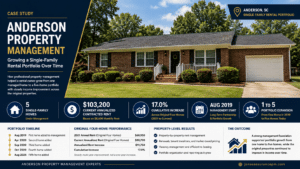
This Anderson property management case study reviews how Jones Assurance Property Management supported a rental owner as a single-family portfolio grew from one managed home to five managed homes.
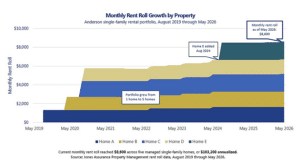
Jones Assurance Property Management began managing the first property in August 2019. Over time, the owners added additional single-family homes to the portfolio, including a fifth property added in 2024.
By the current rent roll, the five-home portfolio produces $8,600 per month, or $103,200 annualized.
The value in this case study is not only rent growth. The stronger story is management continuity, owner portfolio expansion, and property-by-property execution over multiple years. As the owners added homes, JAPM continued managing lease timing, renewals, tenant transitions, rent positioning, and reporting across a growing Anderson-area rental portfolio.
From one managed home in 2019 to a current five-home portfolio producing $103,200 in annualized contracted rent, this case study reflects both portfolio expansion and long-term property-level rent management.
Executive Summary
From the initial management relationship through the current rent roll, Jones Assurance Property Management helped support portfolio growth while maintaining steady rent roll management across the original homes.
5 single-family homes under management: the portfolio grew from one original managed home to five managed homes
$103,200 current annualized rent roll: based on the current monthly rent roll of $8,600
Portfolio expansion supported over time: the owners added additional properties to management after the original home
$80,700 current annualized rent roll across the original four-home portfolio: compared to $68,950 in 2021 annual rent
17.0% cumulative increase across the original four-home portfolio: a steady multi-year improvement, not a one-year rent increase
Property-by-property execution: rent decisions were managed through renewals, tenant transitions, onboarding, and market-based pricing
Portfolio Snapshot
Property addresses, owner names, and tenant names withheld for privacy.
Category
Detail
Portfolio Type
Single-family rental portfolio
Market
Anderson area
Original Management Start
August 2019
Original Managed Portfolio
1 single-family home
Current Managed Portfolio
5 single-family homes
Current Monthly Rent Roll
$8,600
Current Annualized Rent Roll
$103,200
Original Four-Home Comparison Period
2021 through current rent roll
2021 Rent, Original Four Homes
$68,950
Current Annualized Rent Roll, Original Four Homes
$80,700
Annualized Rent Roll Increase, Original Four Homes
$11,750
Cumulative Increase, Original Four Homes
17.0%
Portfolio Growth Over Time
This case study reflects a long-term management relationship that expanded as the owners added properties.
JAPM began by managing one Anderson-area single-family home in August 2019. Additional homes were brought under management in 2020, and a fifth home was added in 2024.
Portfolio Milestone
Timing
First home added to management
August 2019
Second home added to management
April 2020
Third home added to management
September 2020
Fourth home added to management
October 2020
Fifth home added to management
August 2024
The portfolio now includes five single-family rental homes with a current monthly rent roll of $8,600, or $103,200 annualized.
That growth matters because it shows more than a one-property assignment. The owners continued adding homes to the managed portfolio over time, which created a larger and more complex rental operation.
The Management Challenge
Managing a growing single-family rental portfolio is different from managing one isolated rental property.
Each home has its own lease timing, tenant history, property condition, rent potential, maintenance profile, and turnover risk. A rent decision that makes sense at one property may not be the right decision at another.
The challenge was to support portfolio growth without treating the homes as interchangeable. As new properties were added, each home needed to be onboarded, evaluated, leased, renewed, maintained, and reported on individually.
The portfolio did not improve through one blanket rent increase. It improved through repeated property-level decisions over several years.
Operating Strategy
The management strategy focused on keeping the growing portfolio organized while making rent and renewal decisions at the property level.
Support Portfolio Expansion
As the owners added properties, the management process had to scale with the portfolio.
Each new home required onboarding, rent review, tenant communication, lease tracking, maintenance coordination, and reporting. For a growing owner portfolio, the management value is not just collecting rent. It is keeping the portfolio organized as the number of properties increases.
By the current rent roll, the portfolio includes five managed homes producing $103,200 annualized.
Continue Improving the Original Four-Home Portfolio
Because the fifth property was added later, the original four-home group should be reviewed separately from the full five-home portfolio.
The original four-home portfolio produced $68,950 in 2021 annual rent. Based on the current rent roll, those same four homes now produce $80,700 annualized.
That represents a $11,750 increase and a 17.0% cumulative increase over the comparison period.
Because this occurred over multiple years, the 17.0% figure should be understood as steady operating performance improvement, not a short-term rent growth event. The more important point is that the original homes continued improving while the owners also expanded the portfolio.
Manage Rent Decisions Property by Property
The rent roll did not move upward in a straight line.
In one case, JAPM accepted a renewal accommodation before later resetting the rent through a tenant transition. That type of decision reflects the difference between maximizing rent on paper and managing property-level income over time.
Across the portfolio, some increases came from modest renewal adjustments. Others came from tenant changes, new lease pricing, or onboarding a new property at its current market-supported rent.
The important point is that rent decisions were not treated uniformly. Each property was evaluated based on its own timing, tenant situation, condition, and market position.
Manage Tenant Transitions and Vacancy Risk
As the portfolio grew, JAPM also had to manage tenant transitions property by property. Some rent improvements came through renewals, while others occurred after a vacancy or tenant change created an opportunity to reset pricing.
That distinction matters. A rent increase only creates value if the property remains leased or is re-leased efficiently. Across the portfolio, the management approach focused on improving rent positioning while avoiding unnecessary downtime.
Performance Results
The following figures reflect contracted rent roll data from the management period and the current rent roll.
Current Portfolio Rent Roll Reached $103,200 Annualized
The full portfolio now includes five single-family rental homes.
Metric
Amount
Current Managed Homes
5
Current Monthly Rent Roll
$8,600
Current Annualized Rent Roll
$103,200
This reflects the current contracted rent roll across all five managed homes.
Original Four-Home Portfolio Showed Steady Rent Roll Improvement
The original four-home portfolio provides a useful view of rent movement across the homes managed for the full comparison period.
Metric
Amount
2021 Rent, Original Four Homes
$68,950
Current Monthly Rent Roll, Original Four Homes
$6,725
Current Annualized Rent Roll, Original Four Homes
$80,700
Annualized Rent Roll Increase
$11,750
Cumulative Increase
17.0%
This is a supporting performance metric, not the primary headline of the case study.
The original four homes improved over time, but the increase occurred across multiple years. That context matters. The stronger point is not that rent increased dramatically in a short period. It is that the original homes continued to move forward while the owners expanded the portfolio from one managed property to five.
Total Portfolio Expanded From One Home to Five Homes
The full portfolio growth is also meaningful, but it should be interpreted as a combination of owner expansion and management continuity.
Period
Portfolio Status
Annual / Annualized Rent Roll
2019 starting point
1 managed home
$15,600 annualized
2021
4 managed homes
$68,950 annual rent
Current rent roll
5 managed homes
$103,200 annualized
This shows how the relationship expanded over time. JAPM began with one managed home and continued managing the portfolio as the owners added additional rental properties.
Property-Level Rent Growth
Each property had its own rent path. The table below uses anonymized property labels and is ordered by onboarding date to show how the portfolio expanded over time.
Property
Onboarded
Starting Rate
Current Rate
Dollar Increase
Percent Increase
Home A
Aug 2019
$1,300
$1,650
+$350
+26.9%
Home B
Apr 2020
$1,400
$1,625
+$225
+16.1%
Home C
Sep 2020
$1,700
$1,900
+$200
+11.8%
Home D
Oct 2020
$1,350
$1,550
+$200
+14.8%
Home E
Aug 2024
$1,850
$1,875
+$25
+1.4%
The lower percentage increase for Home E should be understood in context. It was added to management in August 2024, so it has had a much shorter management history than the original four homes.
The property-level history also shows that the portfolio was managed through individual decisions rather than a single rent policy. Some homes had larger rent movement, while others had more modest adjustments based on lease timing, tenant history, market position, and how long the property had been under management.
Why This Case Study Matters
Single-family rental portfolios often grow in stages.
An owner may begin with one rental home, then add another property as confidence, financing, or investment opportunity allows. As the portfolio grows, management complexity increases. Lease dates, maintenance needs, renewal decisions, tenant communication, rent reviews, vacancy risk, and reporting all become more important.
This Anderson property management case study shows how long-term portfolio management can support both portfolio expansion and ongoing property-level income improvement across single-family rental homes.
The key insight is that portfolio growth and operating performance should be evaluated separately. A larger rent roll can come from adding more properties. Stronger portfolio performance comes from managing each property well over time.
It also shows why rent growth should be evaluated alongside vacancy, tenant retention, and the timing of each property’s lease cycle.
In this portfolio, both happened.
Methodology
This case study uses contracted rent roll data from August 2019 through the current rent roll.
The current annualized rent roll is based on the current monthly contracted rent roll of $8,600, multiplied by 12, for a current annualized rent roll of $103,200.
The original four-home portfolio comparison begins in 2021 because that was the first full year with all four original homes active. The 2021 annual rent for those four homes was $68,950. Based on the current rent roll, those same four homes now produce $80,700 annualized.
The 17.0% cumulative increase refers specifically to the rent roll increase across the original four-home portfolio, not the full five-home portfolio. This distinction avoids overstating performance by including the property added later. Because the increase occurred over a multi-year period, it should be read as steady scheduled rental income improvement rather than a one-year rent increase.
Property addresses, owner names, and tenant names are intentionally excluded for privacy.
Performance is presented at the portfolio level based on documented rent roll and scheduled income tracking during the management period. Figures are rounded to standard reporting levels for clarity.
The analysis reflects documented lease, rent, and portfolio tracking data collected during active management.
Final Outcome
Jones Assurance Property Management helped support the portfolio as it grew from one Anderson-area single-family rental home to five managed homes. The management relationship expanded over time as additional Anderson-area rental homes were added to the portfolio.
The current five-home portfolio produces $8,600 per month, or $103,200 annualized.
Across the original four-home portfolio, annualized rent roll increased from $68,950 in 2021 to $80,700 based on the current rent roll.
That represents a $11,750 increase in annualized rent roll, or a 17.0% cumulative increase across the original four homes.
The performance improvement was driven by portfolio onboarding, market-based rent review, renewal management, tenant transition management, vacancy awareness, and property-by-property rent decisions over time.
Firm Profile
Jones Assurance Property Management operates across residential rental homes, small multifamily properties, and select mixed-use assets in Anderson, Easley, Greenville, and Upstate South Carolina. The firm’s approach includes rent analysis, leasing execution, tenant communication, renewal management, maintenance coordination, reporting, and operational review of property performance.
This case study documents one example of Anderson property management execution based on actual operating and rent performance data.
This case study reflects one portfolio’s actual performance. Results vary by property condition, location, tenant demand, rent positioning, lease timing, vacancy, tenant history, owner acquisition activity, and owner objectives.
Case Study FAQ
What type of portfolio is this case study based on?
This case study is based on an anonymous single-family rental portfolio in the Anderson area. The portfolio grew from one managed home to five managed homes over the management relationship.
When did Jones Assurance Property Management begin managing the portfolio?
Jones Assurance Property Management began managing the first home in August 2019.
How many properties are currently in the portfolio?
The current portfolio includes five single-family rental homes.
What is the current rent roll?
The current contracted monthly rent roll is $8,600, or $103,200 annualized.
Why does the case study separate the original four-home portfolio from the full five-home portfolio?
The fifth property was added later, so including it in every comparison would overstate rent growth from management performance alone. The original four-home comparison gives a clearer view of the homes managed for the full comparison period.
How much did the original four-home annualized rent roll increase?
The original four-home portfolio increased from $68,950 in 2021 annual rent to $80,700 annualized based on the current rent roll. That is an $11,750 increase, or a 17.0% cumulative increase over the comparison period.
Should the 17.0% increase be read as a one-year rent increase?
No. The 17.0% increase occurred over a multi-year period. It should be understood as steady rent roll improvement across the original four-home portfolio, not a one-year rent increase.
Did every property increase by the same percentage?
No. Each home had its own rent path. Some properties had larger increases through tenant transitions or market resets, while others had more modest adjustments based on lease timing, tenant history, market position, and how long each property had been under management.
Why mention a renewal accommodation?
The renewal accommodation shows that rent decisions were not made mechanically. In some cases, preserving stability may be more appropriate than forcing the largest possible increase immediately. The goal is to improve long-term portfolio performance, not simply maximize one lease event.
How did vacancies or tenant transitions affect the portfolio?
We handled vacancies and tenant transitions on a property-by-property basis. Some rent improvements came through renewals, while others occurred when a vacancy or tenant change created an opportunity to reset pricing. The goal was to improve rent positioning while avoiding unnecessary downtime.
Does this case study guarantee similar results?
No. This case study reflects one portfolio’s actual performance. Results vary based on property condition, location, tenant demand, rent levels, lease timing, vacancy, owner acquisition activity, and owner objectives.