
Upstate SC Rental Market Update – May 2026
May 12, 2026
Rising Utility Costs Are Becoming a Bigger Part of the Rental Conversation in the Upstate
May 16, 2026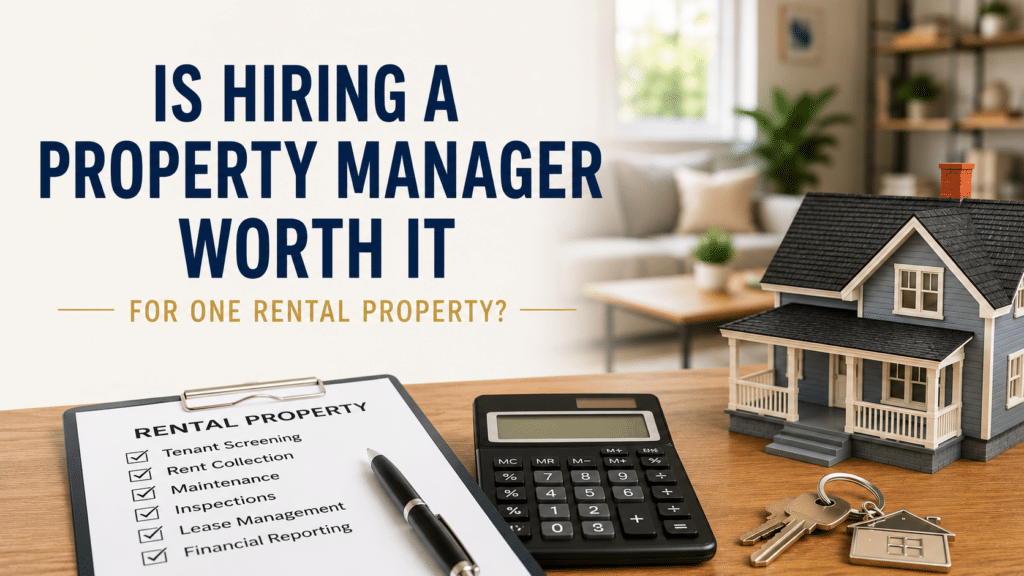
For many accidental landlords and small investors, one of the first questions that comes up after buying, inheriting, or moving out of a home is simply Is hiring a property manager worth it?
The honest answer is: sometimes yes, sometimes no.
Self-managing a rental property can make sense for organized owners with strong communication skills, good documents, reliable vendors, and the time to stay involved. However, many owners underestimate how much consistency, planning, and risk management goes into operating even a single rental home well over the long term.
The better question is not whether every landlord needs a property manager. The better question is whether professional management would create enough value, reduce enough risk, or save enough time to justify the cost for your specific situation.
For landlords in Easley, Greenville, Anderson, and the broader Upstate South Carolina market, the answer often depends less on the number of properties you own and more on how involved you want to be in the day-to-day operation of the rental.
The Biggest Misconception About Property Management
A common misconception is that property management is primarily about collecting rent.
In reality, most of the work happens around:
- Preventing problems
- Reducing vacancy
- Handling maintenance efficiently
- Screening tenants properly
- Staying consistent with lease enforcement
- Having systems in place before something goes wrong
Many self-managing landlords do perfectly fine when everything is going smoothly. The challenge usually appears when:
- A tenant stops paying
- Maintenance issues become frequent
- Communication breaks down
- An eviction becomes necessary
- The owner simply becomes too busy
That is often when owners realize that managing a rental property is less about collecting income and more about consistently operating a small business.
When Self-Managing a Rental Property Can Make Sense
There are situations where self-management is a completely reasonable choice.
Self-managing may make sense if:
- You live close to the property
- You have flexible availability
- You are highly organized
- You are comfortable handling difficult conversations
- You understand landlord-tenant laws and lease enforcement
- You have reliable vendors already in place
- You genuinely want to stay involved
For example, an owner with one rental home in Easley who works locally, enjoys hands-on involvement, and has strong systems may do very well self-managing.
Some landlords also prefer maintaining direct control over:
- Tenant communication
- Maintenance decisions
- Leasing
- Financial oversight
There is nothing inherently wrong with that approach. Many successful investors started by self-managing before eventually deciding whether outsourcing made sense for their goals.
Where Many Self-Managing Landlords Struggle
The challenge is that rental properties rarely fail because of one major issue. More often, small operational problems slowly compound over time.
Examples include:
- Inconsistent screening
- Delayed maintenance responses
- Weak lease documentation
- Poor rent pricing
- Emotional decision-making
- Lack of follow-through
A landlord may save 8% to 12% in management fees while simultaneously losing money through vacancy, underpricing, tenant turnover, or maintenance issues that were not handled quickly enough.
Those costs can quietly outweigh the management fee itself.
This is especially common with accidental landlords who never intended to become long-term property operators.
The Real Value a Property Manager Brings
The value of a property manager is usually not in doing one thing differently. It is in creating consistency across dozens or hundreds of small decisions.
A professional property management company typically handles:
- Marketing the property
- Professional photography and listings
- Tenant screening
- Lease preparation
- Maintenance coordination
- Inspections
- Rent collection
- Lease renewals
- Vendor communication
- Accounting and owner reporting
- Legal notices
- Eviction coordination if necessary
More importantly, a good property manager already has systems built around these processes.
That matters because systems tend to reduce delays, emotional decisions, inconsistent enforcement, and preventable mistakes.
Property Manager vs Self-Managing: A Realistic Comparison
| Category | Self-Managing | Professional Property Management |
|---|---|---|
| Leasing and Marketing | Owner handles listings and showings | Structured marketing systems and leasing processes |
| Tenant Screening | Varies by landlord | Standardized screening procedures |
| Maintenance Coordination | Owner receives calls and coordinates vendors | Centralized vendor coordination and maintenance handling |
| After-Hours Emergencies | Owner responsibility | Typically handled through maintenance systems |
| Lease Renewals | Owner-managed | Renewal coordination and market analysis |
| Rent Pricing | Often based on online estimates | Market-driven rental analysis |
| Inspections | Depends on owner consistency | Scheduled inspection processes |
| Legal Notices and Evictions | Owner responsibility | Process-driven documentation and eviction coordination |
| Reporting | DIY tracking | Owner portals and financial reporting |
| Time Commitment | Can vary significantly | Largely outsourced |
This does not mean every property manager performs at a high level. Some are excellent, while others create frustrations of their own.
The key question is not whether property management exists. It is whether the company actually has strong operational systems, communication, market knowledge, and accountability.
Is Hiring a Property Manager Worth It for One Rental?
For many owners, this is the real question.
And surprisingly, the answer is often yes.
Not because one rental property is difficult by itself, but because one poorly managed rental can still create major stress, legal exposure, unexpected vacancy, and time-consuming maintenance issues.
A single property still requires:
- Lease enforcement
- Maintenance coordination
- Tenant communication
- Accounting
- Inspections
- Renewals
- Vendor management
The workload does not disappear simply because the portfolio is small.
In many cases, owners with one property benefit from professional management because they do not already have systems in place, do not have vendor relationships, and do not want to become full-time landlords.
This is particularly true for:
- Accidental landlords
- Owners who moved out of the area
- Inherited property owners
- Busy professionals
- Owners who want the rental to operate more like an investment
What About the Cost?
In the Upstate South Carolina market, residential property management fees commonly range around 8% to 12% of collected rent depending on the property, services included, and management structure.
At first glance, many landlords understandably focus on the monthly fee.
But the better question is usually:
What is poor management costing me already?
For example:
- Pricing the property $100 per month below market equals $1,200 per year
- One extra month of vacancy can erase years of management fee savings
- A poorly screened tenant can create thousands in losses
- Delayed maintenance often becomes more expensive later
That does not automatically mean hiring a property manager is the right decision. But it does mean the conversation is more nuanced than simply comparing fees.
The Importance of Rent Pricing
One area that is frequently overlooked is rental pricing strategy.
Many landlords rely entirely on:
- Zillow estimates
- Nearby listings
- What the mortgage payment is
- What they hope the property will rent for
- Emotional attachment to the property
Professional rent pricing is usually more detailed than that.
An experienced local property manager studies:
- Active competition
- Leasing velocity
- Seasonality
- Demand by area
- Property condition
- Pet policies
- Local inventory trends
In markets like Easley, Greenville, and Anderson, small pricing mistakes can significantly impact vacancy time.
For owners trying to estimate their rental income potential, tools like a rental income calculator can help provide a starting point before making management decisions.
Use the rental income calculator
What Good Property Management Should Actually Look Like
Not all property management companies operate the same way.
A good property manager should provide:
- Clear communication
- Strong documentation
- Transparent expectations
- Market knowledge
- Consistent systems
- Reliable owner reporting
Owners should ask questions like:
- How are tenants screened?
- How are maintenance requests handled?
- Who coordinates after-hours issues?
- How are renewals approached?
- What inspection processes are used?
- How are evictions handled?
- What reporting tools are available?
A property manager should be able to clearly explain their operational process rather than simply promising vague results.
Why Some Owners Eventually Transition Away From Self-Management
Many landlords who eventually hire property managers are not necessarily failing.
Often, they are simply reaching a point where:
- The time commitment no longer makes sense
- Life becomes busier
- They move farther away from the property
- They want the rental to behave more like a passive investment
- They acquire additional properties
That transition frequently happens after having children, changing careers, relocating, or experiencing a stressful tenant or maintenance situation.
The question shifts from:
Can I self-manage?
to:
Do I still want to?
How Jones Assurance Property Management Approaches the Question
At Jones Assurance Property Management, we do not believe every owner automatically needs full-service property management. Self-management can work well for the right person with the right systems.
However, our role is to help owners understand what professional management is designed to protect against: vacancy, inconsistency, weak documentation, poor pricing, maintenance delays, tenant issues, and unnecessary stress.
For owners in Easley, Greenville, Anderson, and surrounding Upstate South Carolina markets, our management approach includes rent pricing analysis, marketing, leasing, vendor coordination, after-hours maintenance coordination, inspections, lease renewals, owner portals, reporting, and end-to-end eviction coordination when needed.
Jones Assurance Property Management also offers several owner-facing guarantees that are designed to create more accountability in the management relationship:
These guarantees are not a substitute for reading the details, but they do reflect an important principle: property management should be built around systems, accountability, and measurable results.
JAPM Performance by the Numbers
While every property and market cycle is different, current internal portfolio metrics reported by Jones Assurance Property Management help show what strong operational systems are intended to produce.
| Metric | JAPM Current Portfolio Performance | General Landlord Benchmark |
|---|---|---|
| Average Days on Market | ~20 days | ~30-40 days |
| Vacancy Rate | <3% | ~7%-10% |
| Lease Renewal Rate | >80% | ~55% |
| Rent Collection Rate | >98% | ~96% |
JAPM figures reflect current internal portfolio performance and may vary by property, pricing, condition, location, and market cycle.
Those numbers help illustrate what many owners are ultimately paying for: systems, consistency, and operational execution.
So, Is Hiring a Property Manager Worth It?
Hiring a property manager is not automatically the right decision for every landlord.
Some owners are excellent self-managers and genuinely enjoy being involved. For organized landlords with strong systems, self-management can absolutely work on a small scale.
But many owners underestimate:
- The operational complexity
- The consistency required
- The emotional strain of difficult tenant situations
- The long-term cost of small management mistakes
The best property managers are not simply rent collectors. They are operational partners designed to reduce vacancy, improve consistency, coordinate maintenance, enforce leases, and protect the owner’s investment over time.
For landlords in the Upstate South Carolina market, especially accidental landlords managing one rental property, that value often becomes more noticeable after experiencing the realities of self-management firsthand.
Helpful Local Resources
If you are comparing self-management and professional property management, these resources may help:
- Easley property management
- Greenville property management
- Anderson property management
- Owner resources
- Rental income calculator
Final Thought
If you are trying to decide whether self-management or professional management makes more sense for your rental property, start by looking at the full picture: time, risk, vacancy, pricing, tenant quality, maintenance, and your own willingness to stay involved.
If you simply want help evaluating your options, you can contact Jones Assurance Property Management for a practical conversation about your property and whether management is likely to make sense.